


Did BMS Overpay or did they get a Good Deal?
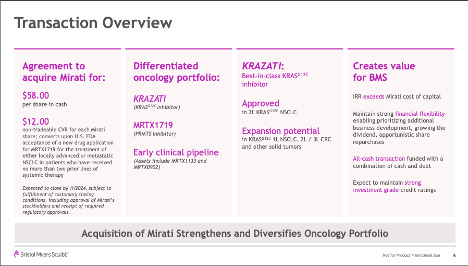
In all honesty, I was planning on writing about Mirati (MRTX) for my “Biotech Buyouts” series this week, after we learned that its closest competitor, Amgen’s LUMAKRAS (sotorasib, KRAS G12C inh), received a negative ODAC vote for its confirmatory phase 3 CodeBreak 200 study in mKRAS G12C patients with 2L+ NSCLC. This vote also occurred in the wake of rumors that Sanofi was nearing a takeout of Mirati. However, BMS beat me (and perhaps Sanofi) to the punch, announcing on Sunday that they agreed to acquire Mirati for $4.8B at a ~52% premium. The deal includes a contingent value right (CVR) valued at ~$1B dependent on FDA acceptance of a NDA for MRTX1719 (PRMT5/MTA inh) in 3L NSCLC.
Comparing the $4.8B takeout price and $52% premium to similar deals as of late, it appears despite a clearly competitive bidding process, BMS paid a fair price for Mirati. Looking at my M&A database, the predominance of acquisitions this year in the $2B-$10B have averaged a $48% premium, so the $52% feels on-market to me, despite the other deals in this range being non-oncology focused. For context, In June 2022, when BMS acquired Turning Point Therapeutics, its first foray into targeted oncology, it paid a 122% premium at $4.1B valuation. Back around that time, Mirati was valued at about ~$2.5B market cap. At its highest point, in December 2020, Mirati was valued at ~$12B.
