

Biogen’s Great Molt is Complete
Having shed its legacy Multiple Sclerosis shell, the company emerges with a hardened focus on Rare Disease and Immunology, solidified by the Apellis acquisition.

Biogen’s BIIB 0.00%↑ multiple sclerosis days are nearly long behind them. With the acquisition of Apellis APLS 0.00%↑ , their transformation into a balanced commercial-stage neuroscience, rare disease, and immunology company is finally complete.
This is a natural course of company’s life in our sector. Regeneron REGN 0.00%↑ was on the ropes while its EYLEA franchise faced generic erosion, but now they’re a major player in immunology and certainly a burgeoning player in oncology and other disease areas as well. Someone like Sanofi SNY 0.00%↑ was once known for being a major player in insulin; that was their bread and butter. But eventually that bread and butter ran out, and they had to pivot into areas like immunology and specialty care.
Not everyone can be a Gilead GILD 0.00%↑ or a Vertex VRTX 0.00%↑ , two companies who have sunk deep roots into HIV and Cystic Fibrosis, respectively, that continue to power their businesses today. Most companies need to shed or molt their skin and transform into something new at one point or another.
The Gradual Shift Away from MS
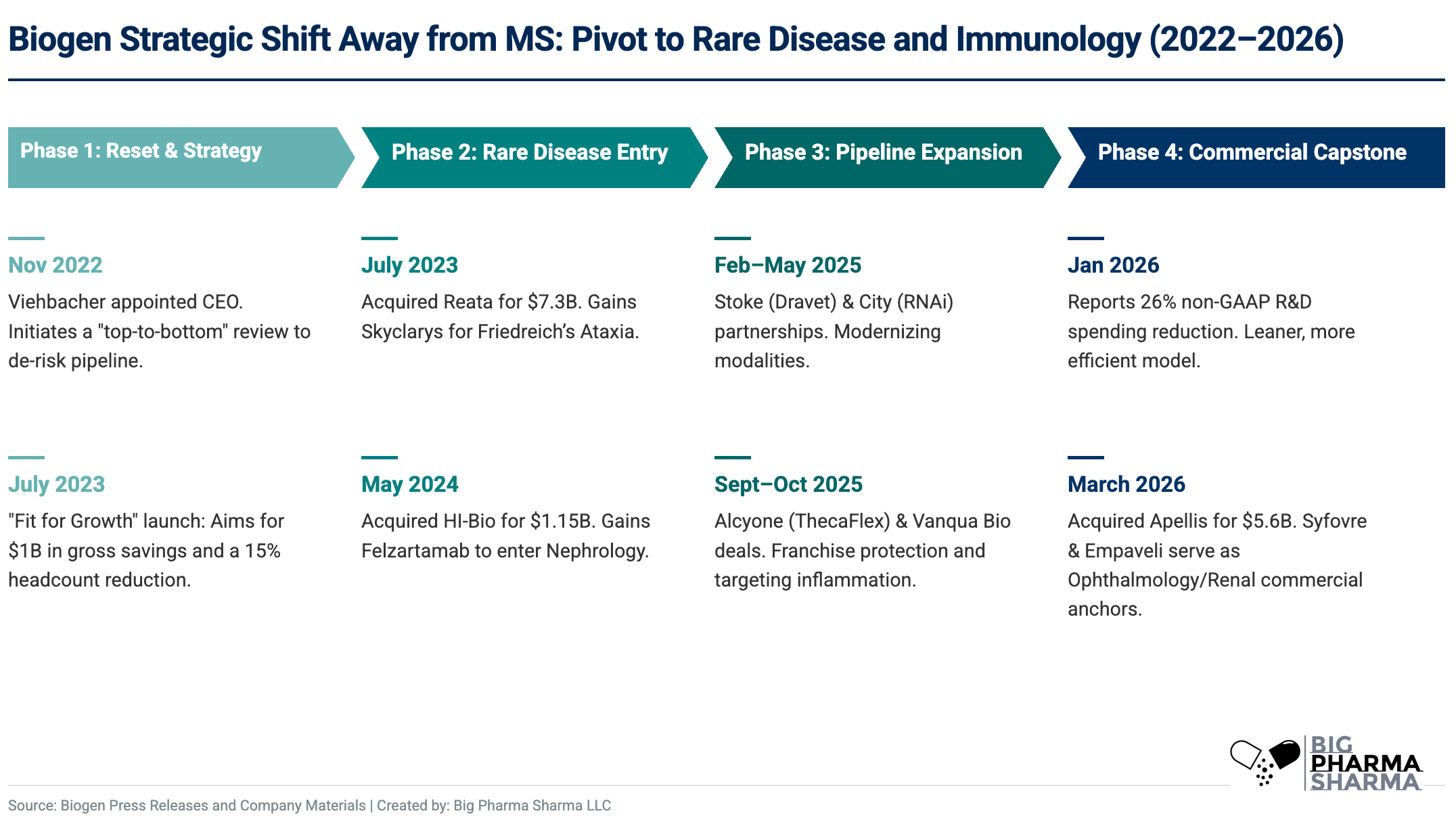
Biogen’s metamorphosis didn’t just happen overnight; it started in 2022 with the hiring of CEO Chris Viehbacher, who formerly led Sanofi SNY 0.00%↑. The company’s legacy multiple sclerosis (MS) franchise faced major patent cliffs. TECFIDERA, which was once a multi-billion dollar behemoth, had been decimated by generic competition, causing sales to plunge nearly 50% in 2025 alone. TYSABRI too, which was Biogen’s long reliable blockbuster, faced biosimilar competition in the same year. To add insult to injury, Roche’s OCREVUS was sort of the primary predator that forced Biogen to need to molt, despite Biogen receiving royalties on this product from their prior collaborations with Roche. OCREVUS continued to grow and take market share from Biogen’s legacy portfolio while 2025 patent cliffs loomed in the distance.
Viehbacher rather quickly kicked off a “fit for growth” initiative in November 2022 netting in a 15% headcount trim and achieving $1B in gross savings. In addition to that, he did a top-to-bottom pipeline review and focused on finding anchor assets that were clinical stage and could eventually become meaningful revenue drivers for the company.
Through that strategic exercise, they decided to focus on building out their CNS rare disease portfolio, as well as their immunology pipeline (which at the time as really just one key asset), with a special focus though on nephrology indications. What this amounted to was a BD spree. Notably, in July 2023, they acquired Reata for $7.3B, gaining access to SKYCLARYS for Friedreich’s Ataxia. Later, they acquired Hi-Bio for $1.15B, adding felzartamab to fuel their entrance into the wide world of nephrology. These two acquisitions were also complemented by multiple R&D collaborations with smaller biotechs focusing on other diseases in the Rare Disease and Immunology buckets.


In January 2026, they continued their efficiency efforts, reporting a 26% spend reduction in R&D, culminating it what appeared to be a solid foundation for the future of the company. New product launches had offset the MS generic erosion declines of the past year, the company was running more efficiently, and had a pipeline set up for multiple near-term late-stage data readouts across newly prioritized disease areas.
This was a company setting up to change into something completely different. The future of the company was staked on assets completely foreign to what existed in 2022, when Viehbacher took over. The optionality from the pipeline came from new high-risk areas, but notably only one MS asset still existed in the pipeline (BIIB091, a peripheral BTK inhibitor). MS has taken a back seat and is now upside only. Out with the old. In with the new.
So even before the announced Apellis acquisition, Biogen was clearly set up to be a rare disease, immunology, neurodegenerative disease player. So why did Biogen acquire Apellis now?
